Attention Is the Product: How the Oldest Trick in Magic Became the Engine of Modern Commerce
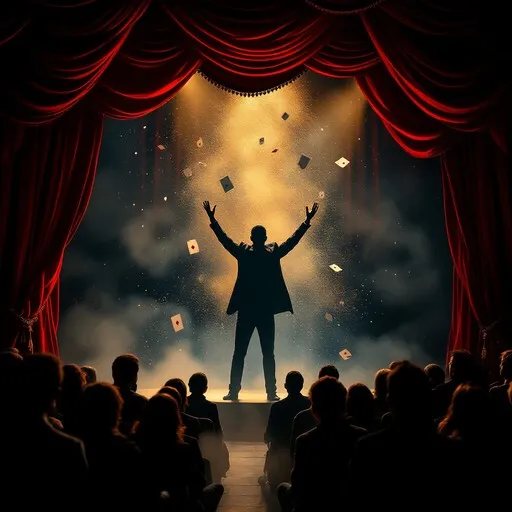
Photo: magician hand gesture misdirection audience attention spotlight stage, via images.stockcake.com
There's a moment in every good magic performance — a breath, a flash, a sudden laugh — where the audience's gaze snaps to one place while the real action happens somewhere else entirely. Magicians call it misdirection. Marketers, algorithm designers, and political strategists just call it Tuesday.
I've spent a long time thinking about how attention works. Not just on stage, where you can physically guide someone's eyes with a gesture or a well-timed joke, but in the broader sense of how human perception gets steered, nudged, and occasionally hijacked. What I keep coming back to is this: the techniques that make a crowd gasp at an empty hand have migrated, wholesale, into the systems that shape what you buy, what you believe, and what you never quite get around to questioning.
And most people have absolutely no idea it's happening.
The Mechanics of Looking Away
Misdirection isn't about creating a distraction. That's a common misconception. A distraction is loud, obvious, almost rude. Misdirection is something far more elegant — it's about making the wrong thing feel like the right thing to pay attention to. The audience leans in. They're engaged. They feel sharp. And that feeling of engagement is precisely what makes the real move invisible.
Now think about the last time you opened a social media app. You were probably looking for something specific — a message, a news update, maybe just a quick scroll to decompress. Within seconds, you were somewhere else entirely. A trending topic. A recommended video. An outrage-flavored headline that had nothing to do with why you opened the app in the first place.
That wasn't an accident. That was a mechanism.
Social platforms are engineered to redirect attention continuously, keeping users in a state of perpetual almost-satisfaction — close enough to what they wanted that they keep scrolling, far enough away that they never quite arrive. The algorithm doesn't just serve content. It performs misdirection at industrial scale, millions of times per second, across hundreds of millions of users.
The Invisible Pitch
Advertising has always borrowed from performance. But somewhere around the mid-2010s, the borrowing got a lot more specific.
Native advertising — those articles and posts that look like editorial content until you squint at the tiny "Sponsored" label — is essentially a misdirection play. You think you're reading a recommendation from someone you trust. The "hand" you're watching is the friendly tone, the helpful framing, the familiar format. The hand you're not watching is the commercial transaction happening underneath.
The same logic applies to influencer marketing, where the endorsement feels like a friend's genuine enthusiasm right up until you notice the discount code tucked into the caption. Or to "freemium" app models, where the free experience is designed specifically to make you look at the premium features — the free tier isn't the product, it's the misdirection that gets you close enough to buy.
None of this is inherently sinister in the way a con is sinister. But it does share DNA with techniques that, when I use them on stage, require the audience's implicit trust. The difference is that I'm using misdirection to give you something — a moment of wonder, a memory you'll carry home. The question worth asking is what you're getting in return when the same tools get deployed in a checkout flow or a political ad.
Politics and the Art of the False Focus
Election cycles are a masterclass in large-scale misdirection, and not always in the cynical way people assume. Sometimes the misdirection is structural rather than intentional — media attention naturally gravitates toward spectacle, personality, and conflict, which means substantive policy often plays the role of the assistant: present on stage, largely unexamined.
Research from the Shorenstein Center at Harvard has documented how campaign coverage in the US consistently prioritizes the "horse race" — who's up, who's down, who said something explosive today — over the actual positions candidates hold on healthcare, housing, or climate. Voters end up extremely well-informed about vibes and extremely under-informed about consequences. The real legislative sleight of hand happens while everyone's watching the debate highlights.
This isn't a partisan observation. It's a perceptual one. When everyone's eyes are on the drama, the mechanics stay hidden.
What Happens When the Audience Looks Up
Here's the thing about misdirection: it only works for as long as the audience doesn't know where to look. The moment someone in the crowd figures out the real point of action, the trick collapses. And increasingly, people are figuring it out.
The backlash against native advertising led to stricter FTC disclosure rules. Growing frustration with algorithmic manipulation has pushed users toward chronological feeds, RSS readers, and deliberately low-tech information diets. The ad-blocker market is enormous. People are getting savvier, and the systems are having to adapt.
But here's what stage magic taught me that I think applies just as cleanly here: knowing the method doesn't always ruin the experience. Sometimes it deepens it. When an audience member understands how a trick works, they can choose to appreciate the craft rather than feel manipulated by it. The difference between wonder and resentment often comes down to consent — did you know you were being played with, and did you agree to the game?
Marketing and media that acknowledges its own mechanics — that says, openly, "we want your attention and here's what we're offering in exchange" — tends to build something that purely manipulative systems can't: actual trust.
Learning to Watch the Other Hand
I'm not suggesting you become paranoid about every ad you see or every post that catches your eye. That way lies exhaustion and a very unpleasant relationship with your phone.
But there's a middle path, and it's one that magicians practice constantly: divided attention. On stage, I'm always tracking multiple things at once — the audience's gaze, the timing, the physical mechanics of what my hands are doing. It becomes second nature. You can develop a version of this as a consumer and a citizen.
Ask, occasionally: what am I not supposed to be looking at right now? When a story is everywhere, what's the story that isn't? When an app is free, what's actually being exchanged? When a message makes you feel a very specific emotion very quickly, who benefits from that feeling?
Misdirection is a tool. Like any tool, it can build something or it can take something. The first step to deciding which is happening is simply knowing the trick exists.
And now you do.