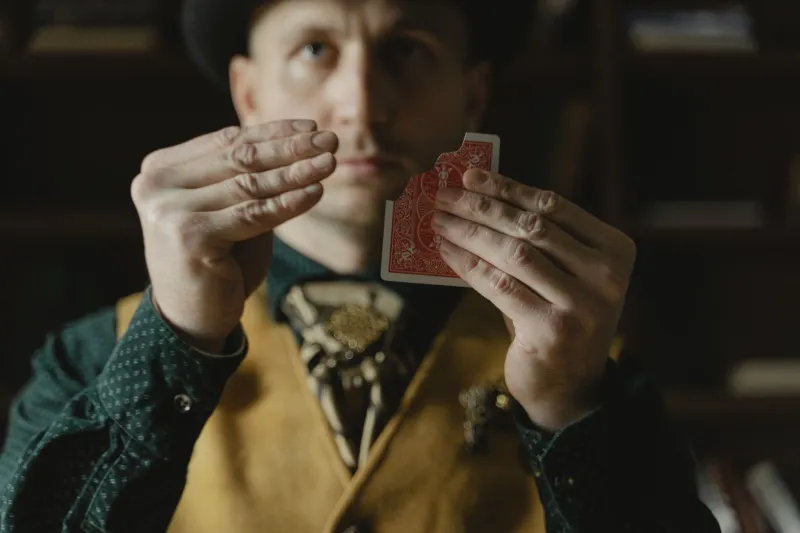
When You Start Believing Your Own Act: The Hidden Cost of Living Inside Your Brand Story

Let me tell you about the most dangerous moment in any performance.
It's not the moment when something goes wrong. You train for that. It's not the moment of highest technical difficulty, because by the time you're performing it, you've done it a thousand times. The most dangerous moment is the one where you stop performing and start being.
Where the character you've built — the expert, the visionary, the artist, the guru — stops feeling like a role and starts feeling like the truth.
I've watched it happen to magicians. I've watched it happen to entrepreneurs, consultants, and creatives. And I've caught myself doing it, which is the only reason I feel qualified to write about it at all.
The Illusion That Works Too Well
Every performer constructs an illusion of themselves. That's not a criticism — it's the job. You develop a persona, a methodology, a way of framing your work that makes it coherent and compelling to an audience. You build a story around what you do and why it matters.
The problem is that a well-constructed illusion is convincing. It's supposed to be. And when you spend years presenting a particular version of yourself to the world, something subtle starts to happen: you begin experiencing the world through the lens of that construction rather than questioning it.
A magician who has spent a decade presenting themselves as unflappable starts to genuinely believe they don't get nervous — and then gets blindsided by performance anxiety at the worst possible moment because they haven't been managing it, just suppressing it.
A business founder who has told the origin story of their company so many times — how they saw the gap in the market, how they knew exactly what needed to be done — starts to remember it that way. The actual confusion and luck and course-correction gets edited out. And then they make strategic decisions based on a confidence in their own instincts that the real origin story wouldn't support.
The Expertise Trap
Here's where it gets particularly sharp for anyone who's built a reputation around knowing things.
Expertise is real. Experience matters. The pattern recognition that comes from years in a field is genuinely valuable. I'm not arguing against any of that.
But expertise also creates a perceptual filter. The more you know about something, the more you interpret new information through existing frameworks. That's efficient — it's how knowledge works. It's also how you miss the thing that doesn't fit the framework, the anomaly that should be a signal, the feedback that contradicts the story.
I've seen this play out in the creative world specifically. A designer who built their reputation on a particular aesthetic starts interpreting client requests through that aesthetic even when the client is clearly asking for something different. A writer who became known for a certain voice starts forcing new work into that voice even when the material wants to go somewhere else. The craft becomes a cage.
In each case, the illusion — the constructed expertise, the signature style, the methodology — is working exactly as designed. It's just working on the person who built it.
What Forgetting You're Performing Actually Looks Like
It rarely looks dramatic from the inside. That's the thing.
It looks like dismissing feedback because "the audience doesn't always know what they want." It looks like interpreting declining results as a temporary anomaly rather than a signal worth investigating. It looks like surrounding yourself with people who've bought into the same story you have, because they feel like the ones who "get it."
It looks like the consultant who's been selling the same framework for fifteen years and has genuinely stopped noticing that the market has changed around it. The startup founder who raised a Series B on a vision that made complete sense in 2019 and is now executing that vision in 2024 without asking whether the assumptions still hold. The artist who stopped making work that challenged them because the work that challenged them wasn't what the audience expected.
The common thread is a kind of insulation. The illusion becomes load-bearing. Questioning it feels like it would bring everything down.
How to Stay on the Outside of Your Own Act
The technique I keep coming back to — both in performance and in everything else — is what I'd call deliberate estrangement. You have to periodically make yourself a stranger to your own work.
In practice, that means seeking out the person who doesn't think you're great and actually listening to what they say. It means asking the question you've stopped asking because you think you already know the answer. It means reading the one-star reviews instead of the five-star ones.
It means being willing to say, out loud: I built this story about myself and my work, and I'm not sure it's still accurate. That's a genuinely uncomfortable sentence to say. It's also one of the most useful.
For creatives specifically, I think the practice of working in mediums or formats that strip away your established competence is underrated. Do the thing you're bad at. Make the work that doesn't fit your brand. Not because it'll become your new direction, but because incompetence is clarifying. It reminds you that the confidence you carry in your area of expertise is earned, not inherent — which means it requires ongoing earning.
The Performer's Responsibility
Here's the thing about illusion, at its core: a great illusion requires that the performer remain clear-eyed about the reality behind it. The magician who forgets how the trick works is just confused. The magic is gone.
The same applies to every constructed identity, every brand story, every methodology. You can present it with full conviction — you should present it with full conviction — while simultaneously maintaining the private awareness that it is a construction, not a fact. That it is a useful frame, not the whole picture.
That distinction, held carefully, is what separates the performer from the performance.
Lose it, and you're not doing magic anymore. You're just lost.